By Aaron Mandel
Friday comes for you before you are finished with the week. The light is already going gold and low, and you are still carrying it all — the unanswered messages, the thing you forgot, the small ache between your shoulders that has no name. You meant to arrive at this evening soft and open. Instead you arrive clenched, the week still running its loop behind your eyes. This is exactly the hour that Kabbalat Shabbat was made for. The word means “welcoming the Sabbath,” and it names the Friday-evening service that greets Shabbat at sundown — a short garland of Psalms and the hymn Lecha Dodi, the moment when the tradition stops working and begins to sing.
You do not have to be ready. That is the first mercy of it. Kabbalat Shabbat does not ask you to have finished anything. It only asks you to turn and face the day that is already coming toward you. The dishes can be undone, the inbox can be full, the long list can be only half-crossed. The service meets you where the week left you and walks you, line by line, somewhere quieter.
What Kabbalat Shabbat Actually Is
Kabbalat Shabbat is a threshold, set into the liturgy in the sixteenth century by the mystics of Safed, who would go out into the fields at dusk to receive Shabbat. It sits between the weekday and the evening prayers — a handful of Psalms strung together, ending in Lecha Dodi, the hymn that calls Shabbat kallah, bride, and welcomes her in. “Come, my beloved, to meet the bride,” it sings, and the whole congregation rises and turns toward the door.
What is striking is how the service does its work. It does not lecture you into rest. It sings you there. The Psalms chosen for this hour are almost all songs of singing — they keep telling you, over and over, to lift your voice before you understand why. “O come, let us sing unto the LORD; Let us shout for joy to the Rock of our salvation” (Psalms 95:1). You begin by singing, and the singing loosens what the week tightened. There is an old wisdom in that order. The body often arrives before the heart does; the voice opens a door the mind is too tired to find. So the tradition does not wait for you to feel restful. It hands you a melody and lets the melody do the carrying.
The LORD Reigns: Letting Something Larger Hold the Week
At the heart of Kabbalat Shabbat are the Psalms that proclaim God’s kingship, and they arrive like a hand laid gently over your racing thoughts. “The LORD reigneth; He is clothed in majesty; The LORD is clothed, He hath girded Himself with strength; Yea, the world is established, that it cannot be moved” (Psalms 93:1). Read that slowly. The world is established. It cannot be moved. All week you have been the one holding things together, and here is the quiet, enormous claim that you were never actually carrying the world at all.
The next Psalm widens it further: “The LORD reigneth; let the earth rejoice; Let the multitude of isles be glad” (Psalms 97:1). The relief hidden inside these lines is not a doctrine to argue about — it is a release. If HaShem reigns, then your grip can loosen. The deadline at sundown is not one more demand on you. It is permission to set the week down, because for the next twenty-five hours, holding it is simply not your job. Notice that the Psalm does not invite only you to rejoice; it calls the whole earth, the far islands, the multitude. Your small tired evening is folded into something vast and steady that was turning toward gladness long before you sat down. You are not asked to generate that joy. You are asked to join a chorus already underway.
Singing a New Song Over a Worn-Out Week
There is a particular kind of tiredness that comes from a week of sameness — the same tasks, the same worries, the same loop. Kabbalat Shabbat answers it with the strangest and most beautiful of instructions: “O sing unto the LORD a new song; Sing unto the LORD, all the earth” (Psalms 96:1). Not the old, exhausted song you have been humming under your breath since Tuesday. A new one.
You may not feel new. That is allowed. The song goes ahead of the feeling and waits for you to catch up. “Sing unto the LORD, bless His name; Proclaim His salvation from day to day” (Psalms 96:2) — from day to day, even the depleted ones, even this one. The practice is not to summon joy you do not have. It is to let your voice take the shape of joy and let the rest of you follow it slowly home. By the time the candles are lit, something in you has often turned that you could not have turned by trying.
The Higgayon Companion — a free seven-day journey in the Psalms
One verse, one reflection, one line to write each day — a taste of the daily practice at the heart of every Higgayon journal. No charge; offered by Higgayon Press.
When the Welcome Becomes Yours
The deepest gift of Kabbalat Shabbat is that the welcome runs both ways. You come to receive Shabbat, and somewhere in the receiving, you are received. The last note these Psalms sound is gratitude — the turn from striving to thanksgiving. “But as for me, in Thy mercy do I trust; My heart shall rejoice in Thy salvation. I will sing unto the LORD, Because He hath dealt bountifully with me” (Psalms 13:6).
Notice what that verse does not say. It does not say He has dealt bountifully because the week went well. It says because He hath dealt bountifully with me — full stop, a settled fact underneath the wreckage of any particular Friday. This is the mercy you have been longing for all week without quite naming it: that you are held by something that does not depend on your performance, and that once a week, at sundown, you are invited to stop and feel it.
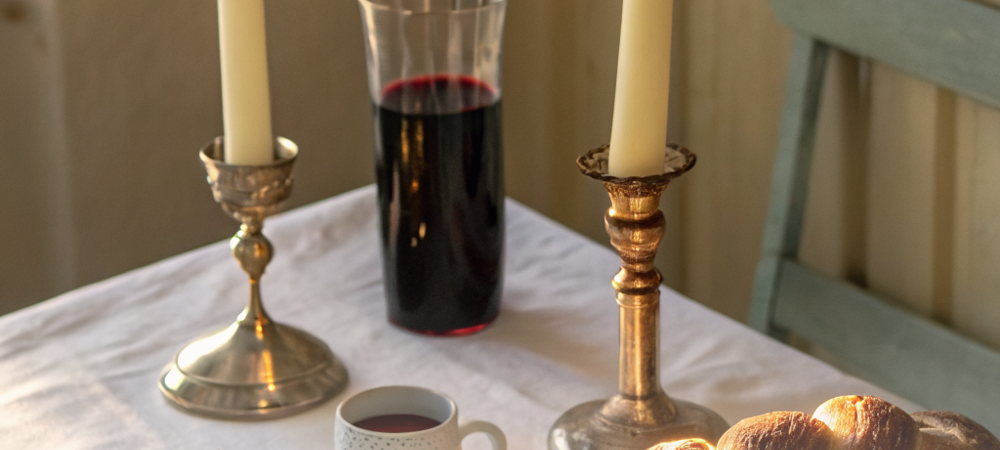
You do not need to be in a synagogue to begin. You can sing one of these lines at your own table, quietly, with the candles in front of you. You can let Lecha Dodi be the moment you turn — physically turn, toward the window, toward the dark — and say, in whatever words are yours, welcome. The bride does not require your readiness. She requires only that you look up.
If you want to keep what these evenings give you, write it down. A few lines after the candles are lit — what the week took from you, what the singing gave back, the one verse that reached you tonight. A Shabbat journal turns Kabbalat Shabbat from an event you attend into a homecoming you can trace, week after week, as the welcome slowly teaches you to rest.
Published by Higgayon Press. For questions of halacha, consult a qualified rabbi.