When You Say Tehillim for Someone You Love and Cannot Fix It
Jewish Healing Workbook — Find Peace in the Psalms When the Waiting-Room Hours Stretch Long
Amazon Book Description
RAW HTML:
If the last three devotionals did not survive past week two, this was built for the week-three reader.
This is a simple daily practice built to meet you in the ordinary week.
For Jewish Caregivers & the Unwell — Comfort & Healing in Illness. Each day sits beside a quoted line from a Jewish writer across the centuries — kept in their own voice, with a quiet word-gloss underneath so the older language opens rather than closes.
Seven stages across 140 days: Stage 1 — Paying Attention — Now · Stage 2 — Opening Your Hands — Quietly · Stage 3 — This Stretch · Stage 4 — The Ground Beneath · Stage 5 — Personally Known · Stage 6 — Offering What You Have · Stage 7 — Completely Near.
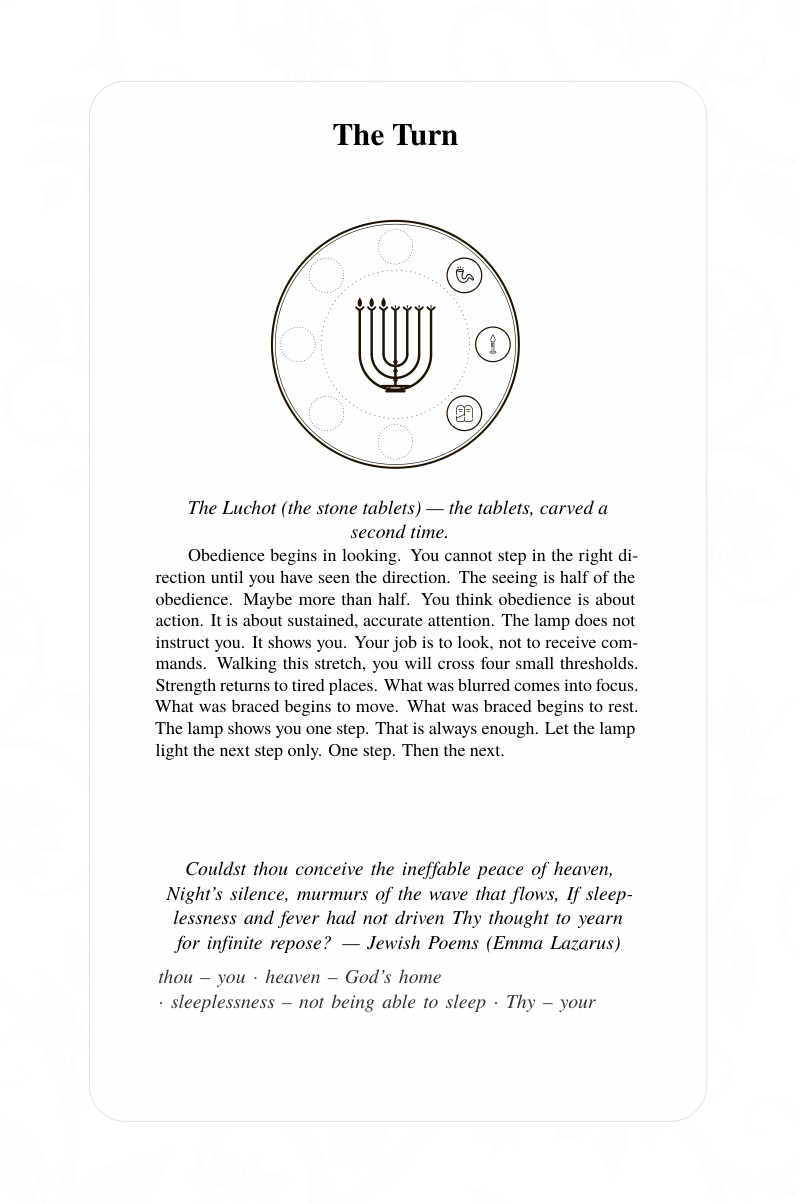
A visual journey across seven simple images — dawn, open hands, a lamp, a mountain, a vine, a stream, and a ring of stars. One image per stage. You will recognise them when you meet them.
Inside these pages you will also find:
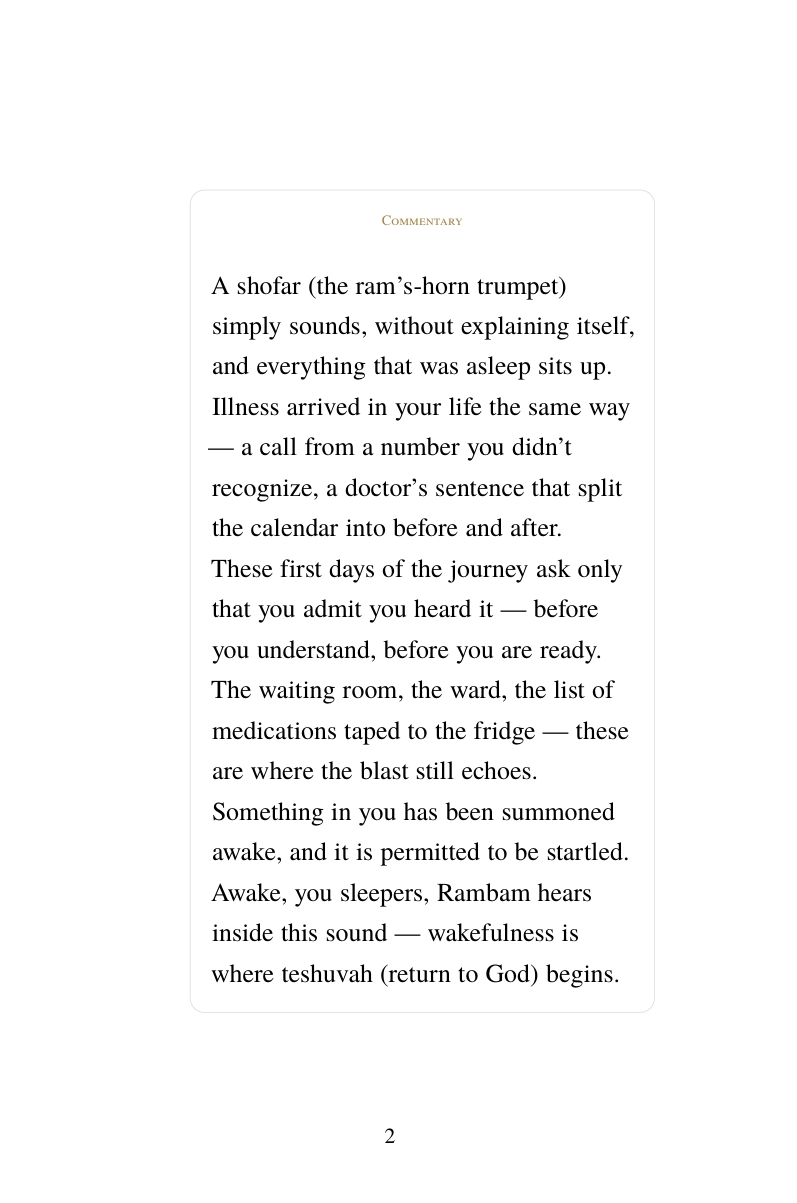
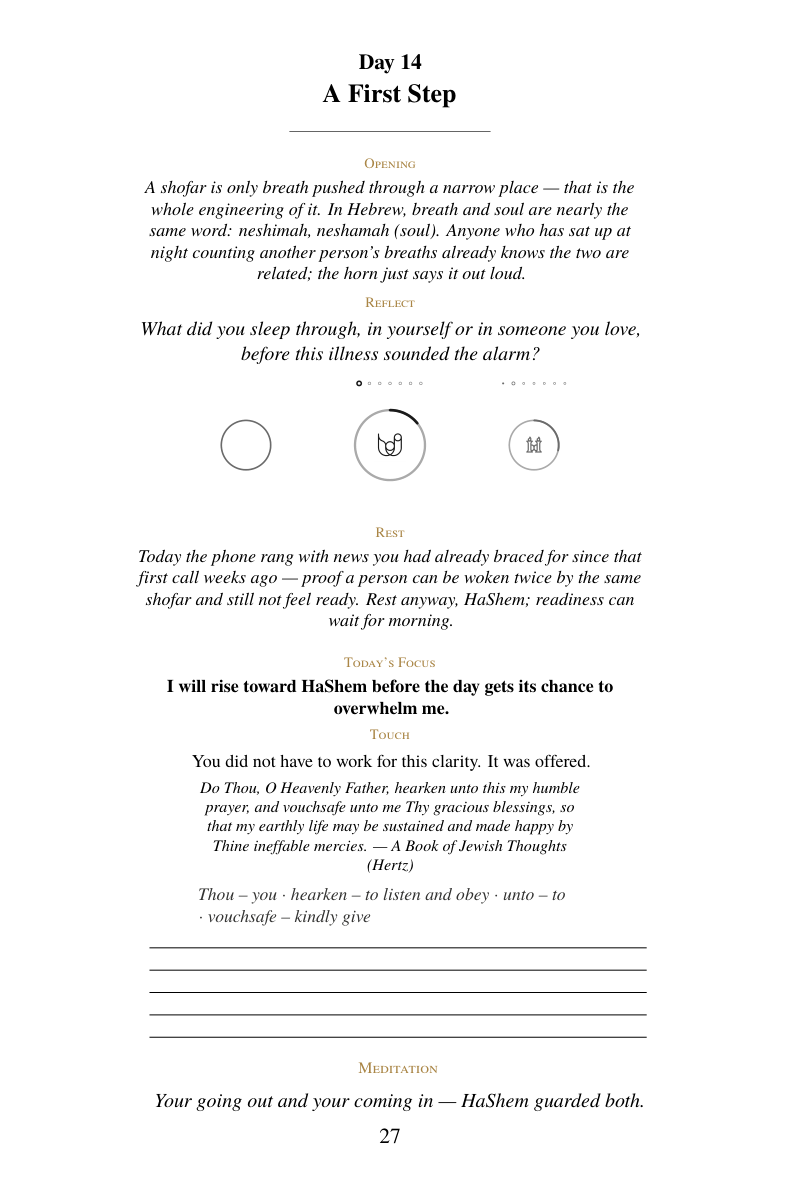
- A consistent daily rhythm, learned once — every page repeats the same gentle structure — an Opening, a Reflect question, a Rest cue for the body, a Today’s Focus, a Touch line tied to the breath, a quoted Jewish writer, and a closing Meditation. Same shape, 140 days.
- Plain-English glosses under every older line — older the Psalms and classic Jewish thought come with their unfamiliar words quietly opened underneath — thee, thou, unto, nearness — so the language never blocks the meaning.
- Quoted writers, always named — every devotional line in the journal carries an attribution — chosen from a curated corpus of trusted Jewish voices across the centuries. The journal does not borrow anonymously from the tradition; it credits where every line came from.
- Section interludes that carry the rhythm forward — between each of the seven sections, a Commentary, a Poem, an A Prayer for This Season page, and a closing Reflection — the journal breathes between stages instead of just numbering them.
- Prayer pages — borrowed and your own — the saints’ prayers carry you when you have no words; A Prayer for This Season pages give your own words a place to land.
- A poem inside each section — between days and decisions, a short unhurried passage holds the stage’s feeling — small enough to remember, deep enough to return to.
Sample prompt: “Let go of the timeline you made for getting better”
Most Jewish journals leave the older language alone and assume you’ll figure it out. This one opens every older line underneath, in plain English, on the same page.
You know that braced feeling — the one you wake up with for no specific reason? Your part, the practice’s part, God’s part — meeting daily. You may fall asleep without running through what might go wrong. You may say what you actually feel the first time. The noise in your head may sort itself before you get out of bed. You carry what you are carrying without flinching. You breathe out without noticing you were holding it. The shape of your day can quietly change you. By your faithfulness, the practice’s structure, and the mercy of God working through both.
Begin today. Not because you feel ready — because the structure will carry you until you are. Open to day one.
Part of the “140-Day Reflective Devotional Journal”.
Preview:
If the last three devotionals did not survive past week two, this was built for the week-three reader.
This is a simple daily practice built to meet you in the ordinary week.
For Jewish Caregivers & the Unwell — Comfort & Healing in Illness. Each day sits beside a quoted line from a Jewish writer across the centuries — kept in their own voice, with a quiet word-gloss underneath so the older language opens rather than closes.
Seven stages across 140 days: Stage 1 — Paying Attention — Now · Stage 2 — Opening Your Hands — Quietly · Stage 3 — This Stretch · Stage 4 — The Ground Beneath · Stage 5 — Personally Known · Stage 6 — Offering What You Have · Stage 7 — Completely Near.
A visual journey across seven simple images — dawn, open hands, a lamp, a mountain, a vine, a stream, and a ring of stars. One image per stage. You will recognise them when you meet them.
Inside these pages you will also find:
- A consistent daily rhythm, learned once — every page repeats the same gentle structure — an Opening, a Reflect question, a Rest cue for the body, a Today’s Focus, a Touch line tied to the breath, a quoted Jewish writer, and a closing Meditation. Same shape, 140 days.
- Plain-English glosses under every older line — older the Psalms and classic Jewish thought come with their unfamiliar words quietly opened underneath — thee, thou, unto, nearness — so the language never blocks the meaning.
- Quoted writers, always named — every devotional line in the journal carries an attribution — chosen from a curated corpus of trusted Jewish voices across the centuries. The journal does not borrow anonymously from the tradition; it credits where every line came from.
- Section interludes that carry the rhythm forward — between each of the seven sections, a Commentary, a Poem, an A Prayer for This Season page, and a closing Reflection — the journal breathes between stages instead of just numbering them.
- Prayer pages — borrowed and your own — the saints’ prayers carry you when you have no words; A Prayer for This Season pages give your own words a place to land.
- A poem inside each section — between days and decisions, a short unhurried passage holds the stage’s feeling — small enough to remember, deep enough to return to.
Sample prompt: “Let go of the timeline you made for getting better”
Most Jewish journals leave the older language alone and assume you’ll figure it out. This one opens every older line underneath, in plain English, on the same page.
You know that braced feeling — the one you wake up with for no specific reason? Your part, the practice’s part, God’s part — meeting daily. You may fall asleep without running through what might go wrong. You may say what you actually feel the first time. The noise in your head may sort itself before you get out of bed. You carry what you are carrying without flinching. You breathe out without noticing you were holding it. The shape of your day can quietly change you. By your faithfulness, the practice’s structure, and the mercy of God working through both.
Begin today. Not because you feel ready — because the structure will carry you until you are. Open to day one.
Part of the “140-Day Reflective Devotional Journal”.