When the Days Blur and You Forget to Say Modeh Ani
Daily Gratitude Workbook — Grow Closer to God When the Small Blessings Slip Past Before You Notice
Amazon Book Description
RAW HTML:
There is nothing to master in these pages. Nothing to perform. Just a steady daily rhythm, opened in plain English, that meets you exactly where the day finds you — and lets the practice do its work.
This is a 140-day guided companion for the unforced return to the Psalms.
For Jewish Women — Gratitude (Hakarat HaTov). Each day sits beside a quoted line from a Jewish writer across the centuries — kept in their own voice, with a quiet word-gloss underneath so the older language opens rather than closes.
Seven stages across 140 days: Stage 1 — A First Step · Stage 2 — A Gentle Release · Stage 3 — On the Way — Steady · Stage 4 — Quietly Continuing — On the Way · Stage 5 — Getting Closer — Quietly · Stage 6 — Caring for Others — Still Real · Stage 7 — Living as One.
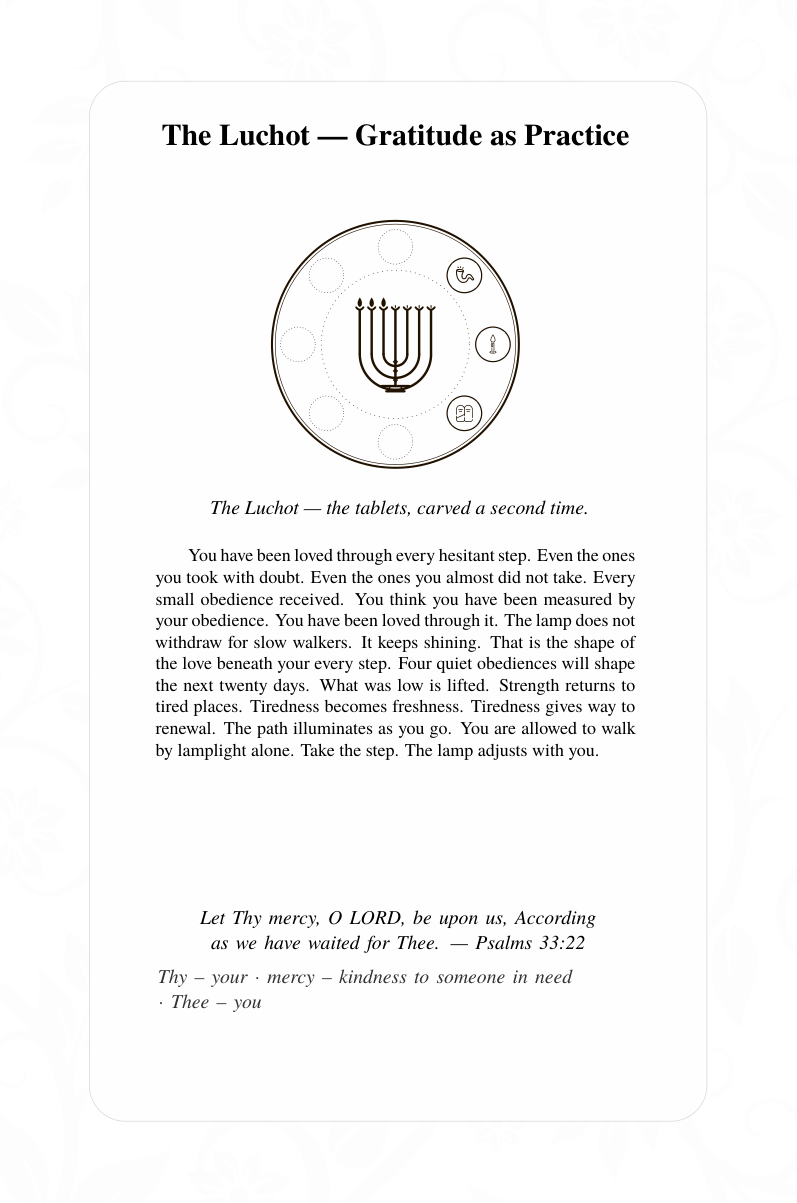
Each of the seven stages carries a single quiet image — the dawn, open hands, a lamp, a mountain, a vine, a stream, a ring of stars. Simple pictures, recognised before they are explained.
Inside these pages you will also find:
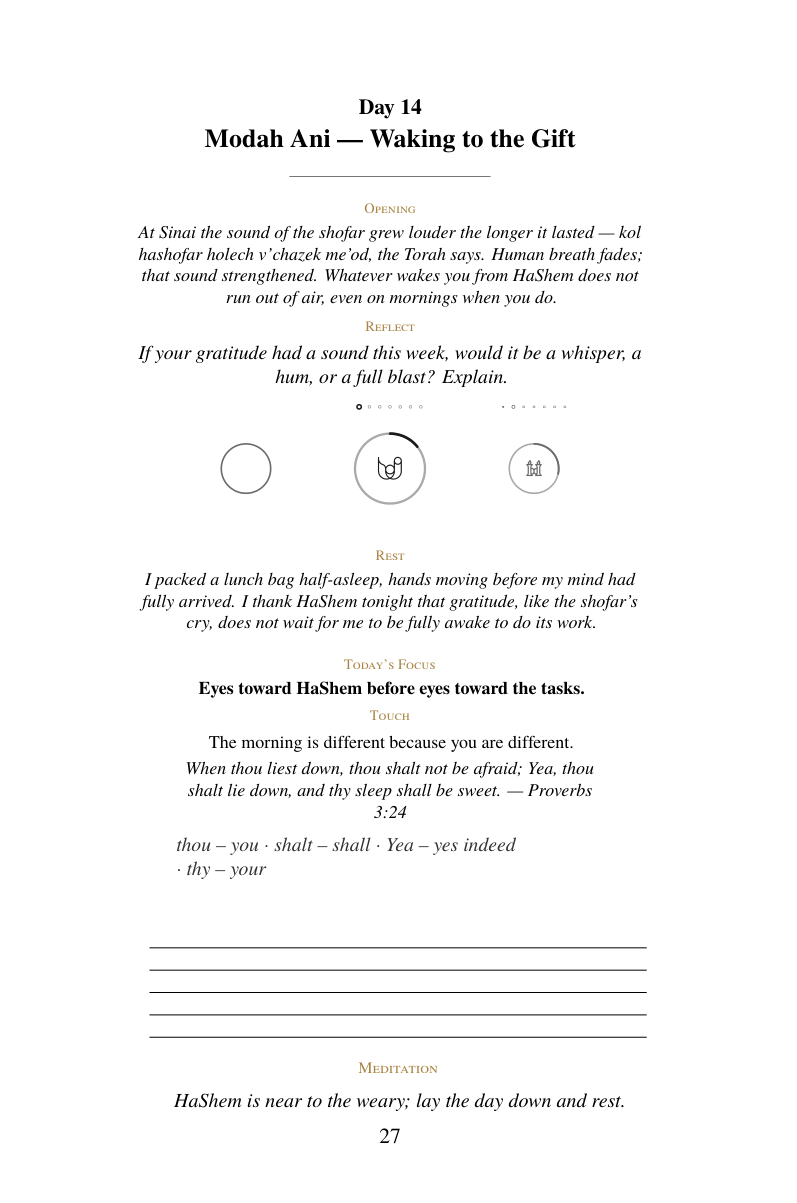
- Seven things on every day’s page — an Opening line. A Reflect question. A Rest cue for the body. A Today’s Focus. A Touch line. A quoted line from the Psalms or a Jewish writer with a word-gloss. A closing Meditation. The same seven elements, every day, for 140 days.
- Older language, opened in real time — thy becomes your. Thee becomes you. Every classic line — the Psalms in older translation, devotional prose from earlier centuries — carries a small plain-English gloss directly underneath. Nothing is left for the reader to puzzle out.
- Real names, never anonymous — every quoted line is attributed — drawn from a curated corpus of Jewish writers across the centuries and chosen to fit each journal’s shape. The voices are named, the sources are known, and the corpus is wider than any single tradition.
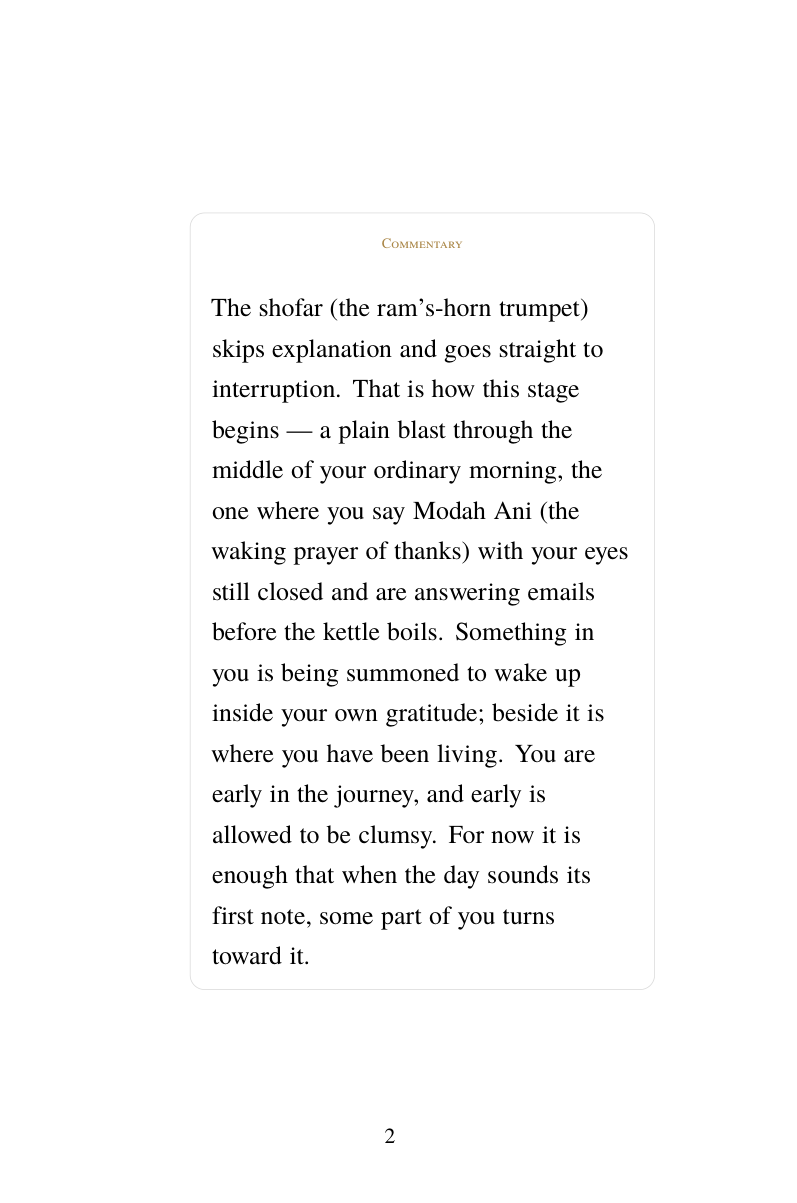
- Liturgical interludes between stages — between the seven sections, the journal slows. A Commentary. A Poem. A Prayer for This Season. A closing Reflection. Real rhythm — not page numbers.
- Borrowed prayers, and yours — selected prayers from saints and faithful authors carry you forward, while A Prayer for This Season pages hold space for the words that are only yours to write.
- One poem per section — short, unhurried passages between stages — small enough to memorise, deep enough to keep returning to.
Sample prompt: “Name the thing today that is simply more than you needed, and let it make you glad”
Most journals quote older the Psalms and hope you understand it. This one opens every older line underneath, in plain English, every time.
Something in you has been waiting to be put down. Where your faithfulness meets a quiet daily shape, mercy tends to be already waiting. You may breathe out without noticing you were holding it. You may say what you actually feel the first time. Your day may have a shape you can move inside. You say no without rehearsing it. You stop bracing for the next thing before it has happened. Day by day, the practice can carry what willpower couldn’t. What was yours was the showing up. What was the practice’s was the shape. What was God’s was the mercy.
Start where you are. The journal meets you there — and walks with you through every honest day that follows. Open to day one.
Part of the “140-Day Reflective Devotional Journal”.
Preview:
There is nothing to master in these pages. Nothing to perform. Just a steady daily rhythm, opened in plain English, that meets you exactly where the day finds you — and lets the practice do its work.
This is a 140-day guided companion for the unforced return to the Psalms.
For Jewish Women — Gratitude (Hakarat HaTov). Each day sits beside a quoted line from a Jewish writer across the centuries — kept in their own voice, with a quiet word-gloss underneath so the older language opens rather than closes.
Seven stages across 140 days: Stage 1 — A First Step · Stage 2 — A Gentle Release · Stage 3 — On the Way — Steady · Stage 4 — Quietly Continuing — On the Way · Stage 5 — Getting Closer — Quietly · Stage 6 — Caring for Others — Still Real · Stage 7 — Living as One.
Each of the seven stages carries a single quiet image — the dawn, open hands, a lamp, a mountain, a vine, a stream, a ring of stars. Simple pictures, recognised before they are explained.
Inside these pages you will also find:
- Seven things on every day’s page — an Opening line. A Reflect question. A Rest cue for the body. A Today’s Focus. A Touch line. A quoted line from the Psalms or a Jewish writer with a word-gloss. A closing Meditation. The same seven elements, every day, for 140 days.
- Older language, opened in real time — thy becomes your. Thee becomes you. Every classic line — the Psalms in older translation, devotional prose from earlier centuries — carries a small plain-English gloss directly underneath. Nothing is left for the reader to puzzle out.
- Real names, never anonymous — every quoted line is attributed — drawn from a curated corpus of Jewish writers across the centuries and chosen to fit each journal’s shape. The voices are named, the sources are known, and the corpus is wider than any single tradition.
- Liturgical interludes between stages — between the seven sections, the journal slows. A Commentary. A Poem. A Prayer for This Season. A closing Reflection. Real rhythm — not page numbers.
- Borrowed prayers, and yours — selected prayers from saints and faithful authors carry you forward, while A Prayer for This Season pages hold space for the words that are only yours to write.
- One poem per section — short, unhurried passages between stages — small enough to memorise, deep enough to keep returning to.
Sample prompt: “Name the thing today that is simply more than you needed, and let it make you glad”
Most journals quote older the Psalms and hope you understand it. This one opens every older line underneath, in plain English, every time.
Something in you has been waiting to be put down. Where your faithfulness meets a quiet daily shape, mercy tends to be already waiting. You may breathe out without noticing you were holding it. You may say what you actually feel the first time. Your day may have a shape you can move inside. You say no without rehearsing it. You stop bracing for the next thing before it has happened. Day by day, the practice can carry what willpower couldn’t. What was yours was the showing up. What was the practice’s was the shape. What was God’s was the mercy.
Start where you are. The journal meets you there — and walks with you through every honest day that follows. Open to day one.
Part of the “140-Day Reflective Devotional Journal”.